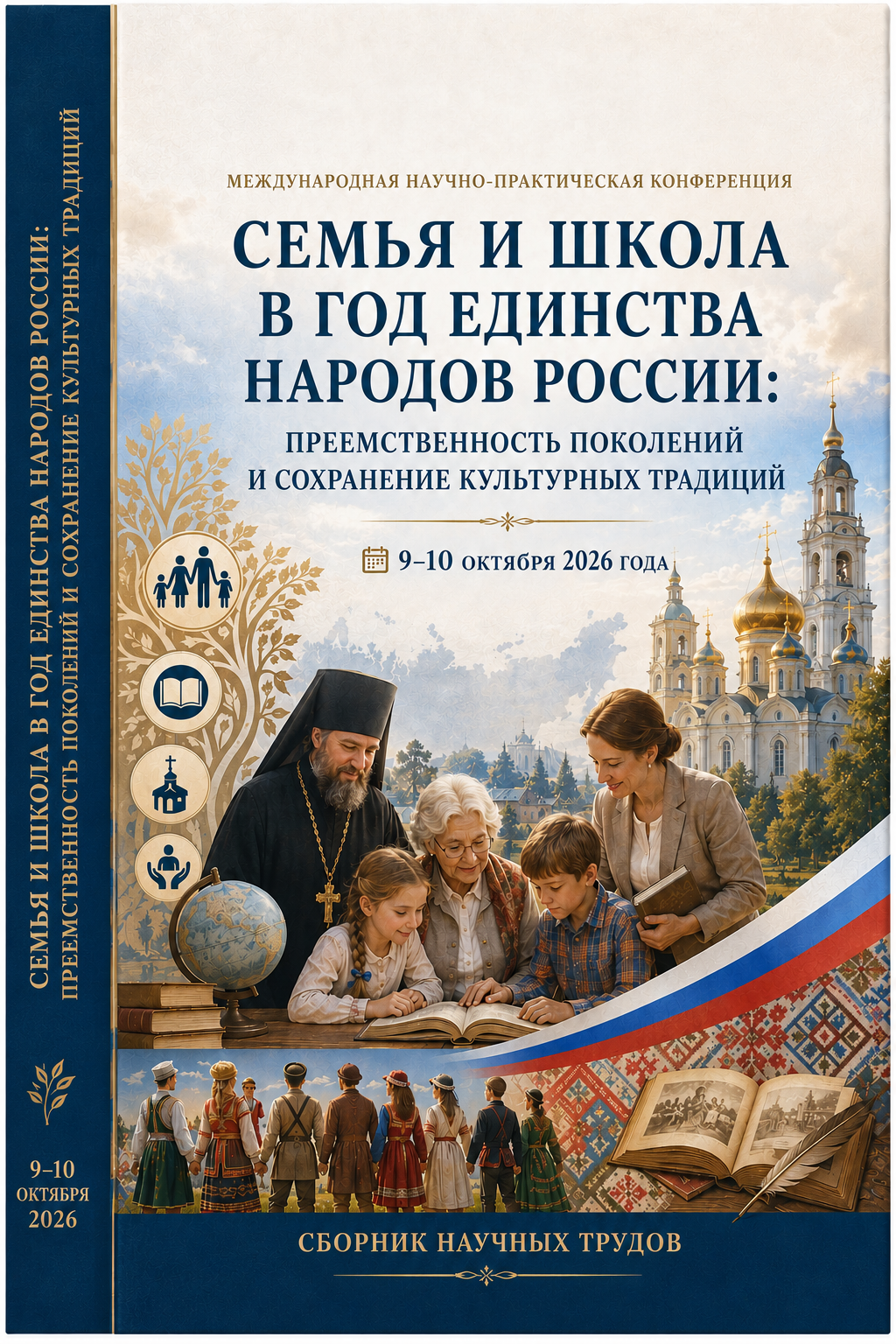
FAMILY AND SCHOOL AS SUBJECTS OF PRESERVING THE UNITY OF THE PEOPLES OF RUSSIA: PARTNERSHIP TECHNOLOGIES
DOI:
https://doi.org/10.5281/zenodo.23281232Keywords:
unity of the peoples of Russia, partnership, multicultural education, educational and upbringing space, event-based technologiesAbstract
The article addresses family–school partnership as a pedagogical condition for preserving the unity of the peoples of Russia and intergenerational continuity. Its purpose is to provide a conceptual rationale for event-based partnership technologies within a multicultural educational space. The methodology rests on systemic-activity, person-centred and axiological approaches, employing theoretical analysis, synthesis, systematisation and pedagogical modelling. The school’s multicultural space is conceptualised as four interrelated components – subject-spatial, social-subjective, psychological and technological – which together foster the value of Russia’s peoples’ unity. The authors develop and substantiate a system of five consecutive technologies – co-informing, co-presence, co-participation, co-involvement and co-reflection – moving from reproductive awareness through role modelling and reflective empathy to creative joint activity and value-based self-determination. Implementation tools include an online glossary of 17 traditional Russian spiritual and moral values, the “One Day with Dad / Mom” campaign, the “Roots and Wings” project, a school museum of the special military operation, volunteer and network projects, and reflective parent meetings. The closely related technologies of co-participation and co-involvement are differentiated by five criteria. Staffing, organisational and environmental conditions are identified, together with risks of formalisation. It is concluded that stage-by-stage family engagement turns parents from passive observers into subjects of upbringing, thereby strengthening the unity of the peoples of Russia. Further research will involve testing the technologies across different types of educational institutions and studying their long-term effects.
Downloads
Published
Issue
Section
License
Copyright (c) 2026 Шевцова Марина Александровна (Автор)

This work is licensed under a Creative Commons Attribution-NonCommercial 4.0 International License.